
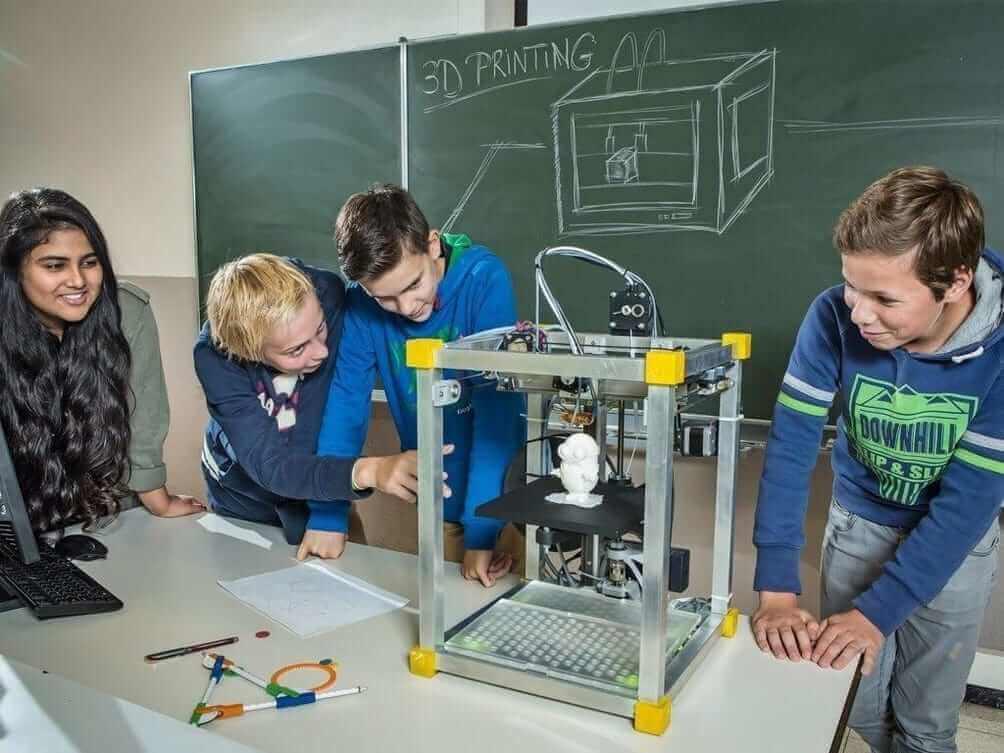
3D PRINTING: The Digital Workshop - From Bits to Atoms
3D printing, or Additive Manufacturing, is the process of creating physical objects from digital designs by building them layer by layer. It represents the most significant shift in manufacturing since the assembly line—democratizing creation by putting the power to design and produce custom parts, prototypes, and art directly into the hands of students, hobbyists, and engineers. It's not just a tool; it's a fundamentally new way to think about solving physical problems.
Core Technology: How Material Becomes Object
The Layer-by-Layer Philosophy
Unlike traditional "subtractive" manufacturing (cutting, drilling, milling), 3D printing is "additive." It starts with nothing and adds material only where needed, minimizing waste and enabling geometries impossible to make any other way—hollow structures, internal channels, and organic shapes.
Primary Consumer Technologies
1. Fused Deposition Modeling (FDM) - The Workhorse
- How it Works: A thermoplastic filament (PLA, ABS, PETG) is fed through a heated extruder, melted, and deposited in precise layers onto a build plate. The printer head moves in X and Y axes; the plate lowers (Z-axis) after each layer.
- Why it Dominates: Affordable, reliable, huge material variety, and relatively safe. It's the gateway technology for 99% of hobbyists and makers.
- Key Components: Extruder, Hotend, Heated Bed, Stepper Motors, Control Board.
2. Stereolithography (SLA/DLP) - The Detail Master
- How it Works: A UV laser (SLA) or projector (DLP) precisely cures (hardens) liquid photopolymer resin layer by layer, pulling the model out of a resin vat.
- The Trade-off: Produces prints with exquisite detail, smooth surfaces, and high accuracy—perfect for miniatures, jewelry, and engineering prototypes. But resin is messy, requires chemical post-processing, and parts can be brittle.
3. Other Technologies (Mostly Industrial):
- Selective Laser Sintering (SLS): Uses a laser to fuse powdered nylon, creating strong, functional parts without support structures.
- Metal 3D Printing: Direct Metal Laser Sintering (DMLS) for aerospace and medical implants.
The Complete 3D Printing Workflow: From Idea to Hand
Stage 1: Digital Design (The Blueprint)
-
CAD Software: This is where the magic begins.
- Beginners: Tinkercad (free, web-based, intuitive blocks).
- Intermediate: Fusion 360 (free for hobbyists, professional parametric design).
- Advanced: SolidWorks, Blender (for organic shapes).
- Downloading Models: Communities like Thingiverse, Printables, and Cults3D offer millions of free and paid pre-made designs.
Stage 2: Slicing (The Translation)
- The Slicer (Cura, PrusaSlicer, Simplify3D) is the most critical software. It's the translator between your 3D model (an .STL file) and your printer's language (.gcode).
- You Control: Layer height, infill density/pattern, print speed, support structures, and temperatures. Mastery of slicing is the key to print quality.
Stage 3: Printing (The Execution)
- Preparation: Leveling the build plate (essential!), loading filament, and preheating.
- Monitoring: The first layer is crucial. After that, it's a waiting game—from 30 minutes for a small part to 30+ hours for a large, detailed model.
Stage 4: Post-Processing (The Finish)
- FDM: Removing supports, sanding, smoothing with filler primer, painting, or acetone vapor smoothing (for ABS).
- SLA: Washing in isopropyl alcohol to remove uncured resin, then UV curing in a light chamber for final hardness.
The Maker's Toolbox: Applications Across Your Hobbies
3D printing is the ultimate cross-disciplinary enabler. Here’s how it integrates with your other passions:
-
Drones & Aeromodelling:
- Prototyping: Iterate custom camera mounts, antenna holders, or frame arms in hours, not weeks.
- Final Parts: Lightweight, aerodynamic ducts, motor guards, and full custom frames (e.g., "TPU" flexible filament for crash-resistant parts).
-
Robotics:
- Custom Brackets & Joints: Create unique servo mounts, sensor casings, and chassis components on-demand.
- Gears & Mechanisms: Print working gears, pulleys, and articulated joints.
-
RC Cars, Ships & Models:
- Scale Details: Railings, vents, wheels, and figures for unparalleled realism.
- Functional Upgrades: Custom shock towers, wheel hubs, and deck fittings.
-
General Prototyping & Tooling:
- Jigs & Fixtures: Make custom tools to help with other projects (drill guides, painting stands).
- Household Solutions: The famous "I'll just print a fix for that" moment—replacement knobs, organizers, phone stands.
Materials: Choosing Your "Ink"
| Material | Best For | Difficulty | Notes |
|---|---|---|---|
| PLA | Beginners, prototypes, display models. | Easy | Biodegradable, low warp, vast colors. Not heat/weather resistant. |
| ABS | Functional parts, car interiors, high-temp applications. | Medium-Hard | Tough, durable, can be smoothed with acetone. Warps easily; needs an enclosure. |
| PETG | Functional parts, outdoor use, drone frames. | Medium | The "Goldilocks" filament. Strong, flexible, chemical/weather resistant. Great layer adhesion. |
| TPU | Flexible parts, gaskets, vibration dampeners, RC tires. | Medium | Flexible and durable. Requires slow print speed and direct drive extruder. |
| Resin (SLA) | High-detail miniatures, jewelry, dental/engineering prototypes. | Medium | Extreme detail. Requires safety gear (gloves, ventilation) and post-processing. |
The Learning Curve: Skills Developed
- Spatial & Design Thinking: Visualizing in 3D and understanding tolerances (how parts fit together).
- Failure Analysis & Troubleshooting: Diagnosing why a print failed (e.g., poor adhesion, under-extrusion, warping) is a systematic science.
- Material Science: Understanding how different plastics behave under heat, stress, and time.
- Patience & Process: Respecting the machine and the methodical nature of creation.
Getting Started: Your First Layer
Phase 1: Learn Before You Buy
- Use Online Services: Upload a design to Craftcloud or a local library's printer to see the process.
- Master Tinkercad: Complete a few basic tutorials to understand 3D design logic.
Phase 2: Your First Printer (Recommendations)
- Under $300: Creality Ender 3 V3 SE – The modern, user-friendly successor to the legendary Ender 3. Auto bed leveling is a must-have.
- Under $600: Bambu Lab A1 – Game-changing speed, reliability, and multi-color capability out of the box.
- For Detail/Resin: Anycubic Photon Mono 2 or Elegoo Mars 3 – Excellent entry-level SLA printers.
Phase 3: The Essential Starter Kit
- Printer
- Filament: 2-3 spools of PLA in different colors.
- Tools: Digital calipers (critical for measuring), flush cutters, a scraper, isopropyl alcohol (for bed cleaning).
- Safety: Good ventilation (especially for ABS/resin), fire safety (a smoke detector nearby, never leave unattended for long periods).
The Future & Beyond
- Multi-Material Printing: Printing with dissolvable supports or integrated electronics.
- Bioprinting & Construction: Printing with living cells or concrete.
- Distributed Manufacturing: The "print-on-demand" economy reducing shipping and waste.
Conclusion: Your Ideas, Tangible
3D printing collapses the distance between imagination and reality. It turns "I wish I had a..." into "I'll design and print one." It is the core tool of the modern maker, empowering you to repair, customize, invent, and express yourself in plastic, resin, and beyond. It teaches you to think not just about what is, but about what can be made.
Ready to Start Your First Print? Begin your journey with our curated [3D Printer Buyer's Guide], [Top 10 Beginner Projects], [Slicer Settings Database], and [Troubleshooting Flowcharts]. The only limit is your design.
| Size | Small, Medium, Large & Extra Large |
| Color | Read, Blue, Green & Black |
| Length | 35 cm |
| Fabric | Cotton, Silk & Synthetic |
| Warranty | 6 Months |
Cobus Bester March 20, 2025
Really happy with this print. The colors are great, and the paper quality is very good.
Cobus Bester March 12, 2025
Really happy with this print. The colors are great, and the paper quality is very good.
Cobus Bester March 11, 2025
Really happy with this print. The colors are great, and the paper quality is very good.