
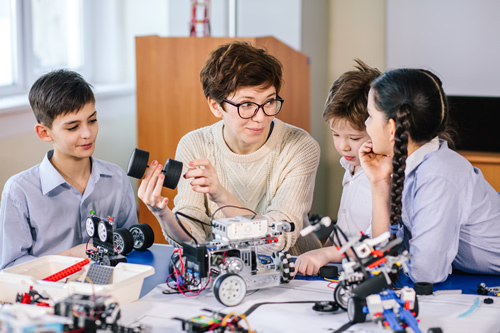
STEM Robotics is not a single subject; it is a dynamic, hands-on fusion of Science, Technology, Engineering, and Mathematics that brings abstract concepts to life. It moves learning from textbooks and screens into the tactile, unpredictable real world. At its core, STEM Robotics is about empowering students to identify problems, design solutions, iterate on failures, and create technologies that interact with their environment. . It is the foundational training ground for the innovators, engineers, and critical thinkers of the 21st century.
The Core Philosophy: The Engineering Design Process in Action
STEM Robotics is built on a cyclical framework of thinking and doing:
- Ask & Imagine: What problem needs solving? (e.g., "How can we automate sorting recyclables?")
- Plan & Design: Brainstorm solutions, sketch designs, and plan the robot's mechanics and code.
- Create & Build: Assemble the physical robot, integrating sensors, motors, and structure.
- Test & Experiment: Run the robot, collect data, and observe its performance.
- Improve & Iterate: Analyze what failed or succeeded, debug code, redesign parts, and try again.
This process normalizes failure as a essential step in learning, fostering resilience, adaptability, and grit.
What Students Actually Learn: The Integrated Skill Set
1. Mechanical Engineering & Physics (The "Body")
- Simple Machines: Gears, levers, pulleys, and wheels in action. Calculating gear ratios to trade speed for torque.
- Structural Integrity: Designing chassis that are both lightweight and strong. Understanding force, balance, and center of mass.
- Kinematics: How the robot moves through its environment.
2. Electrical Engineering & Systems Integration (The "Nervous System")
- Circuit Fundamentals: Creating complete circuits from a power source (battery) through a microcontroller to outputs (motors, LEDs).
- Sensor Integration: Using inputs (touch, ultrasonic, light, color, gyro) to allow the robot to perceive its world.
- Signal & Power Management: Understanding voltage, current, and how to power multiple components reliably.
3. Computer Science & Computational Thinking (The "Brain")
- Algorithmic Thinking: Breaking down complex tasks into a logical, step-by-step sequence.
- Coding Fundamentals: Learning core concepts like loops, conditionals (if/else), variables, and functions in block-based (Scratch, Blocks) or text-based (Python, C++) languages.
- Control Systems: Writing code that creates feedback loops (e.g., "if the distance sensor reads less than 10cm, stop the motor").
- Debugging: The critical skill of systematically finding and fixing errors in logic or syntax.
4. The "Soft" Superpowers
- Collaboration & Teamwork: Working in groups to delegate tasks, communicate ideas, and integrate subsystems.
- Project Management: Defining scope, managing time and resources for a tangible goal.
- Creative Problem-Solving: There is never one "right answer" in robotics, fostering innovative thinking.
- Technical Communication: Presenting and documenting their design process and results.
Age & Stage Progression: Pathways from Novice to Innovator
| Stage | Typical Age | Platforms & Tools | Core Learning Focus |
|---|---|---|---|
| Foundational (Early Elementary) | K-3 | Screen-free kits (STEM Bots, Code-a-Pillar), Very simple block-based (KIBO, Bee-Bot). | Sequential thinking, cause and effect, basic mechanics. Play-based introduction to commands. |
| Beginner (Upper Elementary) | 4-6 | LEGO® Education SPIKE™ Essential, WeDo 2.0, VEX 123. | Drag-and-drop block coding, simple sensor integration (tilt, distance), introductory engineering design. |
| Intermediate (Middle School) | 6-9 | LEGO® MINDSTORMS® EV3/SPIKE Prime, VEX IQ, Micro:bit, mBot. | Complex block coding, multi-sensor data fusion (using 2+ sensors together), structured engineering process, team-based challenges. |
| Advanced (High School & Beyond) | 9-12+ | VEX V5/VEXcode Pro (C++), Arduino, Raspberry Pi, FIRST Robotics Competition (FRC) kits. | Text-based programming (Python, C++), advanced mechanics (4-bar lifts, swerve drive), CAD design (Onshape, Fusion 360), pneumatics, vision processing, and full-system integration. |
The Competitive Arena: Where Skills Meet Passion
Competitions provide a thrilling, real-world context for learning. They are a culmination of every STEM skill.
- FIRST® LEGO® League (FLL): For ages 9-16. Combines a robot game on a themed mat with an innovative research project. Emphasizes Core Values like gracious professionalism.
- FIRST® Tech Challenge (FTC): For grades 7-12. Teams design, build, and code medium-sized robots to compete in an alliance format.
- FIRST® Robotics Competition (FRC): The "varsity sport for the mind." High school teams have just six weeks to build industrial-sized robots (up to 125 lbs) for a complex game.
- VEX Robotics Competition: A globally structured competition with year-over-year progression from VEX IQ (plastic) to VEX V5 (metal), culminating in the VEX Robotics World Championship.
Tools, Platforms, and Ecosystem
- Hardware Kits: Purpose-built educational kits (LEGO, VEX, Makeblock) provide reliable, standardized components. Open platforms (Arduino, Raspberry Pi) offer limitless flexibility for custom projects.
- Software & IDEs: Age-appropriate coding environments from icon-based to professional-grade (VEXcode, RobotC, Arduino IDE, ROS).
- Simulation Software: Tools like VEXcode VR or FIRST Sim allow for coding and testing virtual robots without physical hardware, lowering barriers to entry.
Career Pathways & Future-Proof Skills
STEM Robotics builds a direct bridge to high-demand fields:
- Robotics Engineer
- Automation & Mechatronics Technician
- Software/Embedded Systems Developer
- Aerospace & Automotive Engineer
- Data Scientist & AI Specialist
- Biomedical Engineer
More importantly, it cultivates the adaptive mindset needed for jobs that don't yet exist.
Implementing a STEM Robotics Program
For Educators & Parents:
- Start with the "Why," Not the "What": Frame challenges around real-world problems.
- Embrace Open-Ended Challenges: Avoid step-by-step instructions. Give constraints (e.g., "move this object"), not blueprints.
- Become a Facilitator, Not an Expert: It's okay not to have all the answers. Learn alongside students and guide their inquiry.
- Showcase the Process: Celebrate prototypes, failures, and iterations as much as final products.
Conclusion: More Than Robots, Building Minds
STEM Robotics is the most effective pedagogy for preparing young people for a complex future. It transcends the simple act of building a machine. It is about cultivating systems thinkers, resilient troubleshooters, and collaborative creators. The robot that rolls off the table at the end is merely the physical proof of a far more valuable product: a confident, capable, and curious human being ready to build, code, and engineer a better world.
Ready to Power Up Your Learning Journey? Explore our curated [Classroom Kits], [Competition Team Resources], [Project-Based Curriculum], and [Professional Development Guides] to ignite the spark of innovation.
| Size | Small, Medium, Large & Extra Large |
| Color | Read, Blue, Green & Black |
| Length | 35 cm |
| Fabric | Cotton, Silk & Synthetic |
| Warranty | 6 Months |
Cobus Bester March 20, 2025
Really happy with this print. The colors are great, and the paper quality is very good.
Cobus Bester March 12, 2025
Really happy with this print. The colors are great, and the paper quality is very good.
Cobus Bester March 11, 2025
Really happy with this print. The colors are great, and the paper quality is very good.